2026-10-17
Technology is changing faster than politics can respond. Free societies are designed to answer to voters every few years, and the risks that could end a civilization play out over different timescales.
I use the term existential risk broadly here to mean risks that if left unmitigated, would lead to some kind of catastrophic civilizational event. These include, but are not limited to, advanced AI, climate change, bioweapons, nuclear proliferation, food security, and so on.
Elections are how free societies hold leaders accountable. They limit the damage an incompetent or unpopular leader can do, since voters can remove them. They also create an event horizon where short term wins are favored over long term investments that pay off after the next election. Moreover, elections reward visible results within a term while effective risk reduction is invisible.
This creates a principal-agent problem where voters want good long-term outcomes, but leaders are rewarded only for results voters can see on a shorter timescale.
Free societies do have the capacity for long-term thinking and have built some institutions resistant to the election cycle. Federal judges in the US, for example, have tenure for life so that their decisions are insulated from politics. Central banks work on a similar principle (14 year term limit in the US, 8 years in Europe).
Autocracies have a different failure mode. Although they are able to enact swift policy changes by issuing top-down edicts, information suppression leaves them less able to course correct.
A society that can handle existential risk must have two properties:
Speed and Durability: it must be able to quickly enact policy that outlasts policymakers.
Error Correction: it must have reliable information about what goes wrong so that it can adjust course.
There is of course a trade off between these two properties. Speed favors concentrated power and error correction favors decentralization.
Free societies already make this trade in an emergency when they grant leaders extraordinary power to move quickly. The risk is that temporary power outlasts the emergency, and the checks that would have corrected a mistake are gone.
In free societies, speed is limited by how quickly voters can achieve political consensus. The further apart voters are ideologically, the slower the rate of progress towards some coherent goal. Through dissent, free societies can often devolve into political gridlock.
Gridlock protects existing policy as well as blocking new policy. When power is divided, a law is just as hard to pass as it is to undo. When it is instead concentrated, the system can change course quickly. There is also this thrashing behavior that occurs when policy made by executive action is undone as quickly as it was made.
A good example of this is the Mexico City Policy, a rule on US global health funding that has been rescinded and reinstated three times by presidents of opposing parties since 1984.
Another example is the Paris climate agreement with the US joining in 2016 and withdrawing in 2020 only to rejoin again in 2021 and withdraw in 2025. I leave it up to the reader to deduce who held office during those periods of transition.
Thrashing is what happens when the two parties are diametrically opposed on an issue. Neither can win the other’s agreement, so whichever holds power acts alone, and the other undoes it when it takes over. Policy made this way can be enacted quickly and undone just as fast. This is what speed without durability looks like.
The net effect on a free society’s ability to address existential risk is negative. Risks that take decades to manage need policy that survives changes in power, and every reversal resets the work.
It is hard to address a risk that the two parties cannot agree on, however real it is. Polarization may be thought of as a meta risk that determines whether a free society can confront the others. A society that cannot agree on a problem cannot sustain a response to it, and a response that is undone every few years is no response at all.
Note that policy reversal across transitions of power is different from error correction. Error correction is a society adjusting course based on evidence about what works.
Predicting the future is a notoriously difficult task where mistakes are inevitable. We do not demand perfect judgement, but rather the ability to course correct when information on the ground calls for us to do so. Societies that punish criticism suppress the feedback they need to correct course.
Li Wenliang was a Wuhan physician who warned his colleagues about a pneumonia outbreak in a group chat in late December 2019. He was summoned by police, forced to sign an admission calling his warning illegal, and warned of punishment if he continued. He died of the virus in early February. In March, a central investigation found the reprimand inappropriate, Wuhan police apologized to his family, and in April the Hubei government named him a martyr.
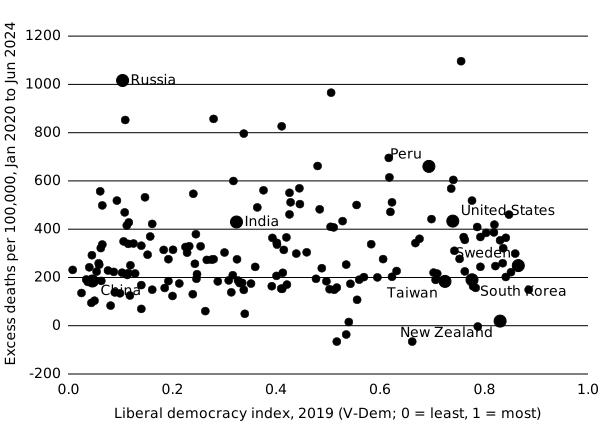
If open societies corrected course better, we would expect them to
have suffered fewer deaths in the pandemic. Below is a raw comparison of
each country’s excess deaths from 2020 to mid-2024 against its 2019
liberal democracy index, without adjusting for age or income. There is
no clear link (Spearman ρ = 0.12, p = 0.13) as open societies did not
fare measurably better.
Silencing critics is not the only barrier to error correction. It is possible, even in free societies, for criticism to fall on deaf ears.
Contrast this with Frances Haugen, a Facebook employee who leaked internal documents to the WSJ and the SEC in 2021. Some of them detailed Instagram’s effects on teenagers’ mental health. That October she testified before Congress, telling senators that “Congressional action is needed”. Three weeks later, Facebook announced that it was now called Meta with the stated reason being a shift in focus to the metaverse. The Kids Online Safety Act followed in 2022. The Senate passed it 91 to 3 in 2024, and the House never held a vote.
Unlike Li, Haugen was not silenced. Her documents were public and she was heard. Hollywood even made a movie about her. The point is that access to information is a necessary but not sufficient condition for error correction.